FID Criminology Delegation Travels to Bonn for Review
June 22, 2026
After we had already submitted our application to the DFG for continued funding of the FID in Criminology as “FIDplus” as of March 1, 2026, we took the next important step toward inclusion in the
FIDplus funding program on June 18, 2026, with the review in Bonn. Since the review in Bonn coincided with a major heat wave, things got hot for the FID Criminology - and not just
figuratively.
The DFG review consisted of two parts. In the first part, a presentation lasting no more than 15 minutes was given to introduce the work of the FID, as well as its unique features and challenges.
Following this, the reviewers appointed by the DFG - who came from the fields of criminology, technology, and library science - had the opportunity to pepper the five-member delegation from the
FID Criminology with questions - though given the already very high temperatures early that morning, the term “grill” seems more appropriate.
After a brief change of rooms, the reviewers then had the opportunity to engage in informal conversations with the various representatives of our delegation during so-called “discussion spots.”
For these discussion spots, we had prepared a number of talking points on both subject-specific, technical, and library-related aspects of the FID in Criminology, which were presented on the
display boards set up for that purpose.
All in all, the review lasted about two hours, and although our delegation was very satisfied overall with the pleasant atmosphere during the review, there was still a palpable sense of relief
once this milestone on the path to transitioning into the FIDplus program had been reached.
Of course, we very much hope that the weeks and months of preparation and effort involved in the application and the review in Bonn will ultimately pay off and that the FID Criminology will make
the leap into the FIDplus program! For now, however, we’ll just have to wait and keep our fingers crossed, as it will still be quite a while before the DFG makes its final decision in December
2026.
New Input from Berlin: The FID Criminology at Bibliocon 2026
May 25, 2026
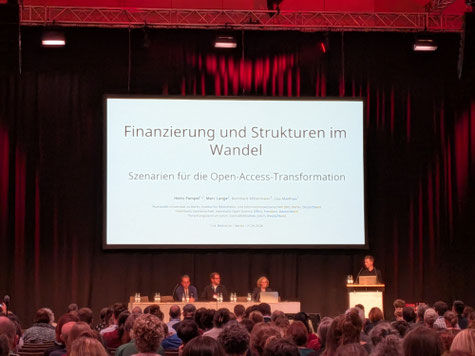
"Analog trifft Algorithmus" (“Analog Meets Algorithm”) was the theme of this year’s BiblioCon, which took place in Berlin from May 19–22, 2026.
BiblioCon is the central professional event for the German library sector. Every year, library staff, information specialists, and representatives from academia, research, and public institutions
gather there to exchange ideas and discuss new projects, trends, and challenges.
For the FID Criminology, a particular focus was on topics such as open access and e-book interlibrary loan. Current developments were presented in various lectures and discussions, and
perspectives for the future provision of scholarly literature were highlighted.
We are excited about the insights and suggestions gained from attending BiblioCon 2026 and look forward to incorporating what we have learned there in order to continuously improve our services
for the criminological reserach community.
Happy Easter!
April 2, 2026

The KrimDok/KrimBlog team wishes you all a happy Easter and good luck with your Easter egg hunt! 😉
It's done! Application for continued funding as FIDplus submitted to the German Research Foundation (DFG)
March 2, 2026

After weeks and months of intensive preparation, brainstorming, and numerous rounds of revisions, we have submitted our application for continued funding of the FID Criminology as “FIDplus” (the
DFG's new funding program) as of March 1, 2026. Yay! 😊
We very much hope that our application for continued funding in the FIDplus program will be successful so that we can continue our work in the next funding period (2027-2031) and continue to
provide our services and information to the criminology community. In addition, we have also planned some exciting new ideas and offerings that will enable us to continue to enrich the
criminology community in the future.
For now, however, it's time to keep calm and keep our fingers crossed! We will keep you posted about the outcome of our grant application.
Your Own Workspace in KrimDok? Why a Free Account Is Totally Worthwhile
January 21, 2026
KrimDok is known to anyone who has been involved in criminology for a while. It is the central bibliographic database for our field, packed with references from books, journals, anthologies, and
gray literature. However, what many people don't know or only use marginally is that with a personal KrimDok account, the database becomes an individual work tool—completely
free of charge. Now, tomorrow, and in the future. No premium model, no subscription, no catches.
Create an account – quickly and easily
Registration is quick and easy: create an account on the KrimDok website, confirm your email address, log in – done. From that moment on, KrimDok is no longer just a place to search, but
a place to organize, create favorites, and share literature lists.

Remember what's important
When conducting research, you come across many exciting titles—but which ones were they again? With an account, you can save relevant references as favorites and access them
again at any time. You can also add your own notes: brief assessments, ideas for citations, or notes on relevance to a project. Your thoughts stay where the literature is.
Keep track of the latest publications – automatically
Research projects usually start with an initial literature search. After that, researchers check more or less sporadically to see if there are any new publications on their research topic.
KrimDok offers convenient support here: the alerting function. To use this function, you need an account so you can enter your email address. Then save a search for your topic,
and you will be automatically notified by email as soon as new references are added to the database. Fewer repeat searches, more time for analysis and writing.
Organize your work – and collaborate
With KrimDok accounts, you can sort references into lists, for example by research projects, courses, or publication plans. You can use these lists for yourself or share
them with colleagues – ideal for teamwork, joint publications, or teaching. And when it comes to writing? No problem: all references can be exported to common reference
management programs such as Citavi, EndNote, or Zotero. This keeps your workflow consistent and efficient.
A KrimDok account offers:
• saved favorites,
• space for personal notes,
• automatic alerts for new publications related to a saved search term,
• structured literature lists,
• export options to bibliography tools.
And all of this is permanently free of charge.
Anyone who uses KrimDok regularly should not miss out on this opportunity. With a KrimDok account, your research becomes a personal knowledge space.
New Year's Newsletter
January 15, 2026

Happy New Year!
January 5, 2026

The KrimDok/KrimBlog team wishes you all a happy new year and all the best for 2026!
Happy Holidays!
December 24, 2025

The KrimDok/KrimBlog team wishes you all a Merry Christmas, happy holidays, and a hopefully relaxing end to 2025. We look forward to being able to quickly and easily inform you about news relating to KrimDok and the activities of the FID Criminology via KrimBlog from 2026 onwards.
Launch of KrimBlog
December 19, 2025
While news about KrimDok and the activities of the FID Criminology used to be available directly in KrimDok under the “News” section, we have now decided on a new format: our new “KrimBlog”! We
are very excited about this and will use this platform from now on to keep you regularly informed about news related to KrimDok and the activities of the FID Criminology. In addition, KrimBlog
also offers us the opportunity to draw your attention to topics and developments in criminology that we consider relevant, or to new research projects, for example.
Of course, you will also find all the older news from recent years in KrimBlog.

Congratulations on Your Habilitation!
December 15, 2025
We congratulate Dr. Nicole Bögelein on her habilitation and on obtaining the venia legendi in the subjects of criminology and sociology.

Workshopseries "Handling Research Data in Criminology"
May 15, 2025
Between May 21, 2025 and July 30, 2025 the FID Criminology is organising various free online workshops on the topic of ‘Handling Research Data in Criminology - Do Data in Criminology Need Management?’. Information on the workshop series and a schedule can be found here.
Hot Off The Press: First KrimDok Publication Appears in KrimOJ
March 31, 2025
The first publication in the specially created section “News about KrimDok” entitled “May we introduce...?” has been published. We hope you enjoy reading it!
Newly Created Section "News about KrimDok" in KrimOJ
January 1, 2025
The open access journal Criminology - The Online Journal (KrimOJ) is launching a new section called “News about KrimDok”, where we will be publishing regular updates on KrimDok and the work of the FID Criminology. Stay tuned!
Start of Partnership with "Qualiservice"
January 1, 2025
The new year brings a new partnership for the FID Criminology, in this case with Qualiservice.
FID Criminology Booth at the KrimG Conference in Tübingen
September 26, 2024
The FID Criminology is represented with a booth at the 18th Conference of the German Society of Criminology. We look forward to you visiting our booth and are excited to talk to you!
FID Criminology Successfull Once Again
January 11, 2024
The FID Criminology will receive funding from the DFG for another three years (2024-2026). We are very excited!
Merry Christmas from KrimDok!
December 20, 2023
New Look for KrimDok
November 6, 2023
The KrimDok website interface has been extensively redesigned, and all changes are now online. All KrimDok users are welcome to explore our new design!
List of Journals Currently Analyzed for KrimDok Updated
June 22, 2021
The list of journals currently analysed for KrimDok has been updated. The list, as well as the overview of criminologically relevant journals with a national licence and the overview of criminologically relevant open-access journals, can be found in the panel. Details on KrimDok under Journals and publication series.
FID Criminology Receives DFG Funding for Another Three Years
January 12, 2021
Last year, the Specialised Information Service for Criminology submitted a renewal proposal for the funding period 2021 to 2023, which was approved in full by the DFG. This will not only enable the FID Criminology to continue its current activities, such as the acquisition of highly specialised domestic and foreign literature and the maintenance of the freely accessible literature reference database KrimDok, but also to implement new projects. In future, for example, there will be a secondary publication service that supports criminological researchers in transferring their articles into open-access publications in compliance with copyright law. The expansion of open access plays an important role overall. In the 2021-23 project period, research data will also be systematically catalogued in KrimDok.
Application for Continued Funding Submitted to the DFG
May 13, 2020
The application for a further three-year funding period (2021-23) has been submitted to the DFG. We hope to receive full funding so that we can expand our range of information and services and thus offer a contemporary service.
Thank You for Participating in Our Survey!
April 21, 2020
The FID Criminology would like to thank all participants in the survey on a possible secondary publication service in the 2021-23 funding period. Your feedback is very valuable for our further planning and for a well-founded cost calculation in the application process.
Overview of the Journals Currently Analyzed for KrimDok
April 9, 2020
The list of journals currently evaluated for KrimDok has been updated. In addition, there is now also an overview of which criminologically relevant journals have a national licence. Both lists and the overview of criminologically relevant open-access journals can be found in the KrimDok details panel under Journals and publication series.
Starting Now: Free KrimDok Account Available
February 1, 2020
It is now possible to create user accounts on KrimDok. Individual searches and favourites can be saved there and sorted into private or public lists. Searches are, of course, still possible without a user account.
FID Criminology Secures Continued Funding
January 1, 2020
The application for continued funding of the FID Criminology (FID) in 2020 was approved. An application for renewed funding, now for another three years, is already in preparation.
Updates from the DFG
May 27, 2019
The DFG has published the results of the evaluation of the ‘Specialised Information Services for Science’ (FID) funding program and the Commission's statement on the evaluation.
Application for Continued Funding Submitted to the DFG
May 17, 2019
The continuation proposal for funding the FID Criminology in 2020 has been submitted to the DFG. Due to internal DFG discussions about a change in the framework conditions since the evaluation of the FIDs, this time only a one-year funding proposal could be submitted according to the previous guidelines. We continue to welcome information requests and ideas for the organisation of the FID Criminology.
New Look for KrimDok "Homepage"
December 17, 2018
The KrimDok homepage has been given a new look. You can now find information about the database and the FID Criminology as well as other announcements from the department, centrally on the newly designed portal page.